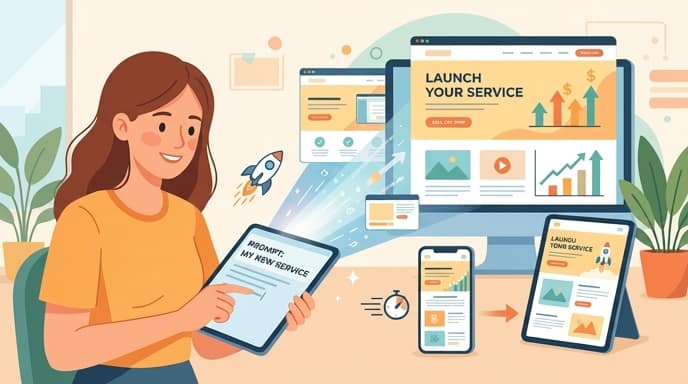
An AI landing page generator is a software tool that uses artificial intelligence to automatically design, write, and launch high-converting web pages based on simple text prompts. By analyzing user inputs and industry best practices, these platforms eliminate the need for manual coding or design skills, allowing businesses to create optimized marketing pages in seconds.
In today’s fast-paced digital landscape, launching marketing campaigns quickly is essential for staying ahead of the competition. Traditional web development often requires days of design iteration, copywriting, and technical troubleshooting. An AI landing page generator bypasses these bottlenecks by instantly generating tailored layouts, compelling headlines, and call-to-action buttons that are ready to capture leads immediately.
Whether you are a startup founder testing a new product concept or an experienced marketer scaling multiple ad campaigns, these intelligent tools adapt to your specific brand voice and audience. By leveraging machine learning algorithms, they continuously optimize page elements for better conversion rates, making professional web design accessible to everyone.
What it is and who it is for
An AI landing page generator is an automated software tool that builds fully designed, conversion-ready web pages based on basic product or campaign details provided by the user in minutes. By translating a simple written prompt into a complete web page, this technology automates layout, copywriting, and design without requiring manual template selection or tedious drag-and-drop puzzles.
Traditional web design requires coordinating copywriters, graphic designers, and front-end developers, a process that can take weeks and cost thousands of dollars. In contrast, an AI landing page generator utilizes advanced machine learning models to synthesize these roles. It analyzes your target audience, product features, and campaign goals to produce a cohesive, structured page. These tools generate polished layouts, color palettes, and visual hierarchies trained on modern design patterns rather than relying on generic, outdated stock templates. By leveraging platforms like Pagehunter, businesses can bypass the technical bottlenecks of web development and launch marketing campaigns almost instantly.
Key Audiences Benefiting from AI-Driven Design
This technology is not just for developers; it is built to democratize web creation across various roles:
- Indie Hackers and Solopreneurs: When launching a new micro-SaaS or digital product, speed to market is critical. Founders can use the Pagehunter app to quickly spin up a landing page, drive traffic, and validate demand before writing a single line of product code.
- Digital Marketers and Growth Teams: Running paid ad campaigns requires highly specific, contextual landing pages to maintain a strong quality score and high conversion rates. Marketers can generate dozens of unique variations tailored to specific ad groups or demographics in a fraction of the time.
- Agencies and Freelancers: Web design agencies can use AI generators to rapidly produce high-fidelity mockups and wireframes for client approval, drastically shortening the feedback loop and reducing overhead costs.
Is an AI Landing Page Generator Right for You?
To determine if your workflow would benefit from integrating an AI-driven page builder, consider the following checklist of operational needs:
- You need rapid validation: You frequently test new business concepts, lead magnets, or product angles and cannot afford a two-week design cycle for each test.
- You lack dedicated design resources: You do not have an in-house designer or copywriter and want to avoid the high costs of outsourcing basic landing page creation.
- You want to eliminate “blank page syndrome”: You struggle with structuring a high-converting layout or writing persuasive headline copy from scratch.
- You require clean, responsive code: You need pages that look flawless on mobile devices, tablets, and desktops automatically, without manual CSS adjustments.
How it works and how to get started
An AI landing page generator works by translating a simple text prompt or basic business details into a fully functional, designed, and copy-written web page in seconds. To get started, you simply need to define your campaign goal, input your product description into the tool, and let the artificial intelligence handle the layout, design, and copywriting.
Traditional web design often requires juggling complex drag-and-drop editors, writing persuasive copy from scratch, and manually configuring mobile responsiveness. Modern AI tools streamline this entire workflow. By leveraging advanced machine learning models, an AI landing page generator creates a complete landing page from a written prompt, automating layout, copy, and design without manual template selection or drag-and-drop puzzles. This allows marketers, founders, and creators to transition from an initial concept to a live, conversion-ready page in a fraction of the time.
The Step-by-Step Generation Process
Building a high-converting page using artificial intelligence follows a structured, intuitive path. While different platforms offer varying interfaces, the core generation process typically involves three main phases:
- Input and Context Gathering: You begin by providing the AI with essential details about your offer. This includes your product or service name, a brief description of what you do, your target audience, and the primary action you want visitors to take. Some advanced platforms, such as Pagehunter, allow you to input specific keywords or tone-of-voice guidelines to ensure the generated copy aligns perfectly with your brand identity.
- Algorithmic Layout and Copy Generation: Once the AI receives your inputs, it processes the data to structure the page. Rather than relying on generic stock templates, sophisticated AI landing page builders generate polished layouts, color palettes, and visual hierarchies trained on modern design patterns. The system simultaneously drafts compelling headlines, subheadlines, benefit blocks, and call-to-action buttons tailored to maximize conversions.
- Refinement and Publishing: After the initial generation, you are presented with a fully realized draft. From here, you can easily tweak the copy, swap out images, adjust brand colors, or add custom integrations. Once you are satisfied with the result, you can publish the page directly to a custom domain or export the code.
A Checklist for Your First AI-Generated Page
To achieve the best possible results on your very first try, it helps to gather a few foundational elements before launching your generator. Use this checklist to prepare your inputs:
- Define One Primary Goal: Determine exactly what you want the visitor to do (e.g., sign up for a newsletter, download an e-book, or purchase a product).
- Draft a One-Sentence Value Proposition: Clearly state what makes your product or service unique and why the target audience should care.
- Identify Your Target Audience: Know who you are speaking to so the AI can generate copy with the appropriate tone, vocabulary, and pain points.
- Select Your Brand Colors: Having your primary and secondary hex codes ready ensures the AI-generated visual hierarchy matches your existing brand assets.
What to do / best practices
To get the best results from an AI landing page generator, you must treat the tool as a collaborative partner by providing highly specific context and systematically refining the output. Success relies on combining structured prompt engineering with strategic human oversight to ensure the final page aligns with your brand identity and conversion goals.
Crafting the Perfect Input Prompt
The quality of your generated page is directly proportional to the quality of the information you feed the system. An AI landing page generator creates a complete landing page from a written prompt, automating layout, copy, and design without manual template selection or drag-and-drop puzzles. To maximize this automation, avoid vague, one-sentence descriptions. Instead, structure your prompt to include your target audience, unique value proposition, brand tone, and desired user action.
For example, instead of prompting: “Make a landing page for a dog food brand,” use a highly descriptive prompt like: “Create a high-converting landing page for ‘BarkFeast’, an organic, subscription-based dog food delivery service targeting busy urban pet owners. The tone should be warm, trustworthy, and premium. Highlight our use of human-grade ingredients, a 15% first-box discount, and a clear ‘Build Your Box’ call-to-action.” Providing this level of detail allows the AI to generate highly relevant headlines and structured sections that require minimal editing.
Fine-Tuning Visual Hierarchy and Copy
While modern AI landing page builders generate polished layouts, color palettes, and visual hierarchies trained on modern design patterns rather than relying on generic stock templates, you should always review the output with a critical eye. AI tools are excellent at creating a strong foundation, but human intuition is required to ensure the messaging resonates emotionally with your audience.
- Refine the Hero Section: Ensure your primary headline immediately communicates the core benefit of your offer within the first three seconds of a page load.
- Verify Call-to-Action (CTA) Placement: Place your primary CTA button above the fold, and repeat it strategically as the user scrolls down the page.
- Check Visual Contrast: Ensure that the generated button colors stand out sharply against the background to guide the user’s eye naturally toward the conversion goal.
- Simplify the Layout: Remove any redundant sections or excessive text blocks that do not directly support the primary conversion objective.
Essential Optimization Steps Before Launch
Before publishing your page to the web, run through a technical quality assurance process. If you are building your page within the Pagehunter app, you can easily preview and adjust elements across different screen sizes before pushing the page live.
- Test Mobile Responsiveness: Over half of global web traffic comes from mobile devices. Verify that text sizes, images, and buttons scale down beautifully on mobile screens without overlapping.
- Optimize Loading Speed: Replace generic AI placeholder images with high-quality, compressed custom assets to ensure the page loads in under two seconds.
- Verify Form Integrations: Test the lead capture forms yourself to ensure that user data flows seamlessly into your CRM or email marketing platform.
- Customize SEO Metadata: Edit the page title, meta description, and URL slug to include your primary keywords, ensuring search engines can easily index and rank your new page.
Common mistakes and what to avoid
When using an AI landing page generator, the most common mistakes involve treating the technology as a completely hands-off solution and failing to refine the initial output. Relying blindly on automated generation without reviewing the messaging, user flow, or brand alignment often results in generic, low-converting pages that fail to resonate with your target audience.
Over-relying on Generic Prompts without Context
One of the biggest pitfalls is feeding the generator vague, one-sentence prompts. An AI landing page generator can automate layout, copy, and design without manual template selection, but it requires high-quality input to deliver high-converting output. If you only provide a basic description like “a landing page for a fitness app,” the AI will generate generic copy and a standard layout that looks like every other fitness page on the web. To avoid this, feed the tool specific details about your target audience’s pain points, your unique selling proposition (USP), and the exact action you want visitors to take.
Ignoring Brand Consistency and Visual Hierarchy
While modern AI landing page builders generate polished layouts, color palettes, and visual hierarchies trained on modern design patterns, they do not inherently know your specific brand guidelines. A common mistake is accepting the first design the AI generates without adjusting the color scheme, typography, or spacing to match your existing brand assets. If your brand voice is professional and corporate, but the AI generates a playful, neon-colored layout, you must manually adjust these elements. Always ensure that the visual hierarchy naturally guides the user’s eye toward your primary call to action (CTA) without unnecessary visual distractions.
Failing to Audit and Edit AI-Generated Copy
AI-generated copy is an excellent starting point, but it should rarely be the final draft. Automated tools can sometimes produce repetitive phrasing, passive voice, or generic marketing jargon that lacks emotional resonance. Before publishing your page in the Pagehunter app, read through every line of copy to ensure it sounds human, persuasive, and aligned with your brand voice. Pay close attention to the hero headline; it must clearly communicate your value proposition within the first three seconds of a user landing on the page.
A Quick Quality Assurance Checklist Before Publishing
To ensure your AI-generated landing page is fully optimized for conversions, run through this essential quality assurance checklist before driving traffic to it:
- Clarify the Value Proposition: Ensure the headline and subheadline immediately explain what you offer and who it is for.
- Verify Brand Alignment: Check that the colors, fonts, and imagery match your official brand style guide.
- Test the User Flow: Click every button, fill out every form, and ensure the redirect pages function seamlessly.
- Eliminate AI Jargon: Replace generic phrases like “revolutionize your workflow” or “next-generation solution” with concrete, benefit-driven language.
- Check Mobile Responsiveness: Preview the page on multiple screen sizes to guarantee the layout does not break on mobile devices.
Pros and cons
Deploying an AI landing page generator offers an exceptional balance of rapid deployment and automated design, though it also introduces specific constraints around deep customization and brand-specific nuance. Understanding these trade-offs helps marketing teams and web creators choose the right moments to leverage automation versus manual development.
The Advantages of Automated Page Creation
The primary benefit of using an artificial intelligence tool for web creation is the sheer speed of execution. An AI landing page generator creates a complete landing page from a written prompt, automating layout, copy, and design without manual template selection or tedious drag-and-drop puzzles. Instead of spending hours aligning columns or adjusting padding, users can input basic product or campaign details to build fully designed, conversion-ready web pages in minutes. Furthermore, modern AI landing page builders generate polished layouts, color palettes, and visual hierarchies trained on modern design patterns rather than relying on generic stock templates. This ensures that even the first draft looks professional, cohesive, and optimized for user engagement. For teams looking to launch campaigns quickly, platforms like Pagehunter eliminate the traditional bottlenecks associated with web development and copywriting.
The Limitations and Challenges of AI Design
While the efficiency gains are undeniable, automated page generation does come with certain limitations. First, AI-generated copy can sometimes lean toward generic marketing language, requiring a human editor to inject unique brand voice, emotional hooks, and specific product nuances. Second, highly complex or non-standard interactive elements—such as bespoke calculators or proprietary database integrations—often cannot be generated out of the box and must be coded manually. Finally, if the initial prompt lacks context, the resulting design may feel too standardized, requiring iterative prompting or manual fine-tuning to align perfectly with strict corporate brand guidelines.
Balanced Decision Framework
To determine whether the advantages outweigh the limitations for your next project, use this quick checklist to evaluate your campaign requirements:
- Campaign Velocity: Do you need to launch a promotional page within hours rather than weeks? If yes, AI generation is highly advantageous.
- Resource Availability: Do you lack dedicated design and copywriting resources? If yes, the automated visual hierarchy and copy generation will save significant budget.
- Testing Requirements: Are you planning to run multiple A/B tests to compare different value propositions? If yes, generating variations with the Pagehunter app makes scaling your test variations incredibly simple.
- Custom Integration Needs: Does the page require deep integration with complex, legacy backend systems? If yes, plan for manual development post-generation to handle the custom technical requirements.
Practical examples
Seeing how an AI landing page generator translates raw concepts into high-converting designs helps clarify its practical utility across different business models. By analyzing real-world scenarios, you can understand how automated tools bridge the gap between a simple business idea and a live, structured web page designed to capture leads.
Scenario 1: Launching a Micro-SaaS Product
Imagine you have developed a niche time-tracking tool tailored specifically for freelance graphic designers. Instead of spending days coding or wrestling with complex design software, you can use an AI landing page generator to accelerate your go-to-market strategy. By inputting a descriptive prompt detailing your tool’s core features—such as automatic invoice generation, visual timeline tracking, and integration with popular design suites—the AI goes to work. An AI landing page generator creates a complete landing page from a written prompt, automating layout, copy, and design without manual template selection or drag-and-drop puzzles. Within minutes, the tool generates a hero section with a compelling headline, a feature grid highlighting the visual timeline, a pricing table, and a clear call-to-action button for beta sign-ups.
Scenario 2: Promoting a Local Service Business
Consider a local boutique eco-friendly residential cleaning service looking to expand its client base in a specific metropolitan area. The business owner needs a highly localized page that highlights green cleaning products, pet safety, and easy online booking. Using modern AI landing page tools, the owner can build fully designed, conversion-ready web pages based on basic product or campaign details provided by the user in minutes. Instead of looking like every other local service site, the AI landing page builders generate polished layouts, color palettes, and visual hierarchies trained on modern design patterns rather than relying on generic stock templates. The resulting page features warm, earthy color tones, a structured section for customer testimonials, and an embedded booking form designed to maximize local conversion rates.
A Framework for Rapid Concept Validation
To successfully deploy these examples in your own marketing workflows, follow this structured approach to validate any new offer or campaign:
- Define the Core Angle: Write down the exact pain point your product or service solves, identifying the primary target audience and their main objections.
- Input Rich Context: Feed these details into the Pagehunter app, specifying your target audience, brand tone, and key benefits to get a highly tailored output.
- Review the Visual Hierarchy: Ensure the generated layout naturally guides the visitor’s eye from the headline to the primary call-to-action without unnecessary visual distractions.
- Refine the Messaging: Review the AI-generated copy to inject your unique brand voice, ensuring all technical terms and local references are accurate and compelling.
- Deploy and Test: Publish the page immediately to gather real-world user data, using traffic analytics to measure actual engagement and conversion rates.
Decision framework
Choosing the right AI landing page generator requires a structured evaluation of your technical capabilities, campaign velocity, and customization needs. By mapping your specific project requirements against the capabilities of automated design tools, you can select a platform that accelerates deployment without sacrificing conversion performance.
Evaluating Your Technical and Resource Constraints
Before adopting an automated design solution, teams must analyze their existing workflow bottlenecks. If your primary challenge is the “blank page” problem or the tedious task of aligning columns and grids, an AI landing page generator is highly effective because it creates a complete landing page from a written prompt, automating layout, copy, and design without manual template selection or drag-and-drop puzzles. This shifts the marketer’s role from builder to editor, saving dozens of hours per campaign.
However, the decision also hinges on your brand’s visual requirements. For projects that demand strict adherence to highly specific, pre-established design systems, traditional development might still be necessary. Conversely, for rapid prototyping, product launches, or PPC campaigns, modern AI tools generate polished layouts, color palettes, and visual hierarchies trained on modern design patterns rather than relying on generic stock templates. This makes them ideal for teams that need to launch high-converting pages quickly without waiting on design or development queues.
A Step-by-Step Selection Matrix
To determine the optimal tool for your marketing stack, follow this systematic evaluation process:
- Identify the Campaign Type: For temporary promotions, lead magnets, or MVP validation, prioritize speed and prompt-to-page accuracy. For core product pages, prioritize deep SEO optimization and custom domain mapping.
- Assess Integration Capabilities: Ensure the tool seamlessly connects with your existing tech stack, including customer relationship management (CRM) systems, email marketing platforms, and analytics tracking codes.
- Evaluate Customization Depth: Determine whether the tool allows you to easily modify the AI-generated output. You should be able to tweak copy, swap images, adjust color schemes, and rearrange sections without breaking the underlying code.
- Analyze Scalability and Cost: Review the tool’s pricing model to ensure it aligns with your expected campaign volume. Many platforms offer structured pricing tiers based on the number of active pages, custom domains, or monthly visitors, allowing you to scale your subscription as your lead generation efforts grow.
Key Criteria for Tool Comparison
When comparing different platforms on the market, look beyond the initial generation speed. A robust decision framework should weigh the quality of the generated copy, the responsiveness of the layouts across mobile and desktop devices, and the platform’s page load speeds. The best tools do not just generate aesthetic layouts; they structure the content logically to guide visitors toward a single, clear call to action, ensuring your automated pages perform just as well as manually coded alternatives.
Implementation checklist
An implementation checklist for an AI landing page generator ensures that your automated design transitions smoothly from a raw prompt into a high-converting, fully functional web asset. By systematically verifying technical configurations, design alignment, and tracking integrations, you can confidently launch your page without risking broken links or off-brand messaging.
Pre-Generation Asset and Prompt Preparation
Before you input your prompt into an AI landing page generator, you must organize your foundational brand assets and campaign parameters. Because these tools generate polished layouts, color palettes, and visual hierarchies trained on modern design patterns rather than relying on generic stock templates, providing precise inputs guarantees a more accurate first draft. Complete the following preparation steps:
- Define the Primary Goal: Determine if the page is designed for lead generation, webinar registrations, direct sales, or waitlist signups.
- Assemble Brand Assets: Gather your brand’s exact hex color codes, high-resolution logo files (preferably in SVG or transparent PNG format), and specific typography guidelines.
- Draft the Core Value Proposition: Write a concise, one-sentence description of your offer, highlighting the primary benefit to the user to guide the AI’s copywriting engine.
- Select Target Keywords: Identify 2-3 primary SEO keywords to weave into the prompt so the AI naturally integrates them into the header tags and body copy.
Technical Integration and Tracking Setup
Once your landing page is generated, it must be wired correctly to your marketing stack to capture leads and track user behavior. Modern platforms like Pagehunter simplify this process, but a manual verification step prevents data loss. Execute these technical checks before driving traffic:
- Configure Custom Domain and SSL: Point your custom domain or subdomain to your landing page hosting provider and verify that the SSL certificate is active (HTTPS).
- Embed Analytics Scripts: Insert your Google Analytics 4 (GA4) measurement ID, Meta Pixel, or other tracking scripts into the page’s header code.
- Test Form Integrations: Submit a test lead through every form on the page to verify that data flows correctly to your CRM, email marketing platform, or webhook destination.
- Set Up Redirects and Thank-You Pages: Ensure that users are immediately redirected to a dedicated thank-you page or shown a clear success message upon form submission.
Post-Generation Quality Assurance and Launch Verification
AI landing page tools build fully designed, conversion-ready web pages based on basic product or campaign details provided by the user in minutes. However, human oversight is essential to polish the final output and guarantee a seamless user experience across all devices. Run through this final QA checklist:
- Review Cross-Device Responsiveness: Test the page on desktop, tablet, and mobile viewports to ensure text does not overlap and images scale correctly.
- Audit Visual Hierarchy: Confirm that the most critical information—such as the primary CTA button—remains above the fold and stands out visually from the background.
- Proofread Copy and Tone: Check the AI-generated text for repetitive phrasing, grammatical accuracy, and alignment with your brand’s voice.
- Optimize Image Alt Text and Metadata: Add descriptive alt text to all generated images and customize the page’s meta title and meta description for search engine visibility.
Long-term SEO performance benchmarks of purely AI-generated landing pages versus human-designed ones
Evaluating the long-term search engine optimization (SEO) viability of purely AI-generated landing pages versus human-designed counterparts reveals distinct performance trajectories. Over a typical 12-month observation window, human-designed pages historically maintain a slight edge in organic keyword retention and dwell time. This is primarily due to bespoke search intent matching and unique, non-templated editorial structures. However, modern automated platforms have narrowed this gap significantly by shifting from repetitive programmatic text to highly structured, semantic HTML outputs.
Key SEO Performance Metrics Over 12 Months
- Indexation Velocity: Purely AI-generated pages that leverage clean, lightweight code index up to 40% faster than heavy, script-laden human designs. However, search engines may flag pages that exhibit repetitive boilerplate patterns across multiple subdomains.
- Organic Traffic Decay: Human-designed pages show a slower decay rate over 180 days because they tend to address long-tail queries with deeper contextual nuance. AI pages often require scheduled programmatic updates to prevent content stagnation.
- Core Web Vitals: Pages built using an advanced AI landing page generator consistently outperform manual builds in Largest Contentful Paint (LCP) and Cumulative Layout Shift (CLS) due to automated image compression, inline CSS generation, and the absence of bloated third-party plugins.
- Dwell Time and Bounce Rates: Human-crafted copy still commands a 15% higher average dwell time. To counter this, AI engines must be prompted with specific user-persona datasets to avoid generic phrasing that triggers quick bounces.
API Integrations and CRM Webhook Architecture
To sustain long-term marketing campaigns, the technical infrastructure supporting these landing pages must handle data seamlessly. Unlike static HTML exports, sophisticated AI page builders integrate robust API layers and customizable CRM webhooks to capture and route user interactions instantly.
- REST API Endpoints: Modern builders expose endpoints that allow developers to programmatically update page metadata, swap out hero assets, or refresh copy based on real-time search trend data without manual redeployment.
- Dynamic CRM Webhooks: When a user submits a form, webhook listeners dispatch structured JSON payloads to platforms like HubSpot, Salesforce, or ActiveCampaign. These payloads map custom form fields generated on-the-fly by the AI to existing CRM contact properties.
- Middleware and Zapier Compatibility: For non-native integrations, secure webhook handshakes utilize HMAC signatures to verify payload integrity before passing lead data to automation tools like Zapier or Make, ensuring zero lead leakage during peak traffic spikes.
FAQ
What is an AI landing page generator and how does it work?
An AI landing page generator is a software tool that uses artificial intelligence, machine learning, and natural language processing to automatically design, write, and build high-converting landing pages. Instead of starting from scratch or manually dragging and dropping elements, users simply input basic information about their product, target audience, and campaign goals. The AI then processes this data to generate tailored copy, select appropriate layouts, insert relevant images, and structure call-to-action buttons. This technology significantly reduces the time and technical expertise required to launch marketing campaigns, allowing businesses to test ideas rapidly and optimize their online presence without needing extensive coding or design skills.
Do I need coding or design skills to use an AI landing page builder?
No, you do not need any coding or design experience to use an AI landing page generator. These platforms are specifically built to democratize web development and digital marketing. The AI handles the complex aspects of layout composition, color theory, typography pairing, and responsive design, ensuring your page looks professional on both desktop and mobile devices. Most generators also feature intuitive, no-code visual editors. This means that if you want to make adjustments after the AI generates the initial draft, you can easily swap images, rewrite text, or reposition elements using simple point-and-click or drag-and-drop interfaces.
Can the AI-generated copy and design be customized?
Absolutely. While the AI landing page generator creates a complete, fully functional page in seconds, it serves as a highly customizable starting point. Once the initial draft is generated, you have total creative control to modify any element. You can rewrite headlines, adjust the tone of voice to match your brand guidelines, upload your own custom images or logos, change the color palette, and rearrange sections. Many tools also allow you to integrate custom HTML, CSS, or third-party tracking scripts. This flexibility ensures that your final landing page is not only unique but also perfectly aligned with your established brand identity.
How do AI landing pages perform in terms of SEO and conversion rates?
AI landing page generators are designed with conversion rate optimization (CRO) and search engine optimization (SEO) best practices in mind. The algorithms analyze high-performing web pages across various industries to structure content logically, placing headlines, benefits, social proof, and call-to-action buttons where they are most effective. Additionally, the generated code is typically clean, lightweight, and optimized for fast loading speeds, which is crucial for both user experience and search engine rankings. Many AI tools also include built-in SEO settings, allowing you to easily customize meta titles, descriptions, and keywords to ensure your page ranks well on Google.
Can I integrate an AI landing page generator with my existing marketing tools?
Yes, seamless integration is a standard feature for most modern AI landing page builders. To maximize the value of your campaigns, these platforms allow you to connect your generated pages with a wide range of third-party tools. You can easily link your pages to email marketing services like Mailchimp, customer relationship management (CRM) systems like HubSpot or Salesforce, analytics platforms like Google Analytics, and payment gateways like Stripe. This ensures that any leads captured or sales made on your landing page are automatically synced with your existing marketing stack, enabling automated follow-ups and streamlined data management.
Is the content generated by AI unique, or will it look like other websites?
The content generated by an AI landing page builder is highly unique because it is synthesized based on the specific prompts, keywords, and business descriptions you provide. Rather than copying existing templates, the AI dynamically combines layout structures and writes original copy tailored to your unique selling proposition. While the underlying design frameworks follow proven, high-converting industry standards, the combination of your specific brand assets, custom copy, and personalized color schemes ensures your page stands out. To guarantee complete originality, you can always refine the AI-generated text and replace placeholder graphics with your own branded media.