
Product page copywriting for dropshipping is the practice of writing persuasive, benefit-driven product descriptions that address customer objections, build immediate trust, and drive impulse purchases. According to research on Shopify’s copywriting guide, effective product page copywriting for dropshipping focuses on clear benefits, trust-building elements, and engaging storytelling, utilizing short sentences and bullet points for readability. By shifting away from dry, supplier-provided technical specifications, you can create a compelling narrative that turns casual visitors into paying customers.
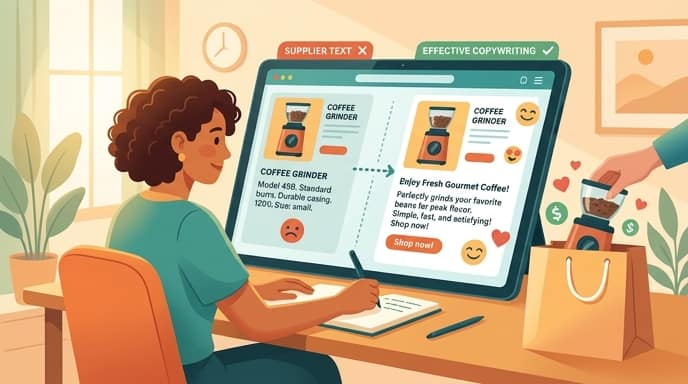
The Dropshipping Trust Deficit: Why Standard Copywriting Fails
Standard dropshipping copywriting fails because it relies on generic, unverified supplier descriptions that ignore customer anxieties about shipping times and product quality. When visitors land on a page filled with broken English, exaggerated claims, and zero mention of shipping timelines, they immediately leave. This skepticism is a major barrier to conversions.
As highlighted in a strategic guide on Medium, strategic copywriting helps turn dropshipping stores from sketchy to trusted by reframing the product page as a two-way dialogue where every line builds trust instead of confusion. Instead of hiding your shipping times or using fake scarcity countdown timers, address your customer’s concerns head-on. Explain your quality control process and clarify shipping expectations to establish a transparent relationship from the start.
Implementing these trust-building copywriting updates yields measurable results. Industry benchmarks show that replacing generic supplier text with optimized, benefit-driven copy and clear trust signals noticeably improves conversion rates and ROAS. This simple shift directly impacts your return on ad spend by turning expensive ad clicks into actual buyers.
Frameworks That Convert: AIDA and PAS for Impulse Buyers
Copywriting frameworks like AIDA and PAS convert impulse buyers by structuring your message to guide readers from initial attention to immediate action. Using structured copywriting frameworks allows you to guide impulse buyers through a logical emotional journey in seconds. These frameworks prevent you from writing aimless paragraphs and keep your copy focused on conversion.
The AIDA framework works exceptionally well for visual or lifestyle products:
- Attention: Hook the reader with a bold, benefit-driven headline.
- Interest: Share an interesting fact, a common struggle, or a unique feature.
- Desire: Paint a picture of how the product improves the customer’s daily life.
- Action: Provide a clear, low-friction call to action.
The PAS framework is ideal for problem-solving products:
- Problem: Clearly identify the core pain point your target audience faces.
- Agitation: Make that pain point feel urgent by highlighting the consequences of ignoring it.
- Solution: Present your product as the ultimate, hassle-free relief to their problem.
Copywriting Framework Checklist
- Identify whether your product is a lifestyle fit (AIDA) or a problem solver (PAS).
- Write three different hook headlines focusing on the primary benefit.
- Ensure your call to action is visible immediately after the desire or solution phase.
Structuring Your Product Page with Scannable Blocks
Structuring your product page with scannable blocks means organizing your copy into short paragraphs, bold headers, and bulleted lists so mobile shoppers can digest key benefits in under five seconds. Most dropshipping traffic comes from social media platforms, meaning visitors have short attention spans.
Lead with primary benefits over dry technical features. Instead of listing “made of 100% ABS plastic,” explain that the product is “built to survive accidental drops and daily wear.” Break up long walls of text to keep the reader engaged as they scroll down the page.
Key takeaway: Never force your visitors to read a wall of text; structure your page so that a five-second scan reveals exactly how the product solves their problem.
Handling Objections and Building Instant Credibility
Building instant credibility requires embedding micro-trust signals directly inside your product descriptions and proactively answering objections about shipping, returns, and product quality. Do not wait for customers to search for your FAQ page; address their hesitations right where they make the decision to buy.
To overcome the common dropshipping trust barriers, integrate these elements directly into your copy blocks:
- Clear Delivery Windows: State your shipping times clearly (e.g., “Ships in 1-2 business days, delivered in 7-10 days with full tracking”).
- Risk-Free Guarantees: Offer a straightforward return policy, such as a “30-day wear-and-test guarantee.”
- Quality Assurance: Explain how you vet your suppliers to ensure the product matches the description perfectly.
Navigating Multilingual Copywriting and Localization Challenges
Navigating multilingual copywriting requires adapting your messaging to match local idioms, buying habits, and consumer expectations rather than relying on basic machine translation. Simply running your English copy through a basic machine translator often results in awkward phrasing, cultural disconnects, and a complete loss of persuasive intent.
Formatting is another critical challenge when dealing with diverse locales. If you target both Western markets and Middle Eastern markets (such as Hebrew or Arabic speakers), your page layout must support both Left-to-Right (LTR) and Right-to-Left (RTL) formatting. Switching from LTR to RTL requires more than just translating the text; it demands mirroring your entire page design, including the placement of images, bullet points, and call-to-action buttons, to ensure a natural reading flow.
When writing for bilingual or multilingual stores, keep your source copy clean and structured. Avoid complex slang that does not translate well, and ensure your e-commerce platform or landing page builder can dynamically adjust its layout rules based on the user’s selected language.
Scaling Product Pages Faster Without Sacrificing Quality
Scaling your dropshipping business requires moving away from manual template writing toward automated page generation tools that maintain high-converting copy standards. Writing unique, persuasive copy for dozens of products manually is slow, inconsistent, and difficult to sustain.
Using an AI landing page generator allows you to maintain professional copywriting standards across your entire catalog in a fraction of the time. With PageHunter, you can instantly turn any supplier product URL into a structured, high-converting product layout optimized for Shopify or WooCommerce. This automated process handles both layout structure and initial copy generation, allowing you to focus your energy on refining hooks and launching ads.
To learn more about optimizing your e-commerce store and scaling your marketing efforts, explore our comprehensive guides on the PageHunter blog. You can explore the available options on the PageHunter pricing page or start building immediately with the PageHunter app.
Frequently Asked Questions
How do I write dropshipping product descriptions that build trust?
To build trust, avoid using generic supplier text and instead write clear, benefit-driven copy. Address shipping times, quality control, and return policies directly on the product page to eliminate buyer skepticism.
What is the best copywriting framework for dropshipping?
The AIDA (Attention, Interest, Desire, Action) framework is best for lifestyle products, while the PAS (Problem, Agitation, Solution) framework works best for problem-solving items. Both help guide impulse buyers toward a purchase decision quickly.
How can I scale copywriting for a large dropshipping catalog?
You can scale your copywriting by using automated tools like an AI landing page generator. These tools turn supplier URLs into structured, high-converting layouts, allowing you to launch products faster without sacrificing copy quality.